Islamabad, 20 August 2025 — Mishal Pakistan, in collaboration with the Faculty of Media & Communication Studies at Riphah International University, organized a seminar titled “Human-Centric Storytelling and Victims of Terrorism: Confronting Violations by Aggressive States.” The event came on the eve of the United Nations International Day of Remembrance of and Tribute to the Victims of Terrorism (21 August), reaffirming solidarity with victims and survivors worldwide.
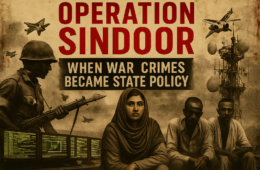
The seminar shed light on the deliberate targeting of Pakistani civilians during Operation Sindoor, when Indian missile and artillery strikes on 7 and 8 May 2025 hit homes, mosques, and marketplaces in Punjab and Azad Jammu & Kashmir. At least 31 civilians, including women and children, were killed, with dozens more injured. Speakers emphasized that such atrocities represent a clear violation of international humanitarian law and global human rights conventions.
In this context, the Marka-e-Haq Shuhda Forum submitted a formal application to the United Nations Mission Observer Group on India and Pakistan, documenting that these attacks, carried out without any legitimate military objective, constituted violations of the UN Charter—including Article 1(1) on the maintenance of international peace and security, Article 1(3) on human rights and fundamental freedoms, Article 2(4) prohibiting the use of force against the territorial integrity of a state, and Article 2(3) requiring peaceful settlement of disputes. The Forum urged the UN to condemn the deliberate targeting of civilians, mandate an independent fact-finding mission, refer the case to the International Court of Justice, and compel India to compensate victims in accordance with international humanitarian law.
Delivering the keynote address, Amir Jahangir, Member Experts Network, World Economic Forum, said, “Operation Sindoor painfully reminded us that civilians are not collateral damage; they are the very soul of our nation. The deliberate targeting of Pakistani civilians by India was a violation of every international legal norm.”
Puruesh Chaudhary, Chair of the Millennium Project, highlighted the long-term needs of survivors, noting, “Victims of terrorism and aggression need more than symbolic solidarity. They require sustained psychological, social, and economic support. Storytelling restores dignity and builds resilience, ensuring that communities heal rather than fracture.”
Tahir Dhindsa, Director of SDTV, SDPI Islamabad, pointed to the media’s responsibility: “Operation Sindoor revealed a pattern of targeting civilians. Media must go beyond headlines to document these realities, amplify survivor voices, and hold aggressors accountable before international opinion.”
Sajjad Azhar, senior journalist and author, stressed memory as justice: “Every victim has a name, a family, and a story. By keeping alive the memory of the atrocities of Operation Sindoor, we resist the silence that aggressors depend on. Justice begins when stories refuse to fade.”
Dr. Riaz Adil, Head of the Department of Media Sciences at Riphah International University, underscored academia’s role: “Universities must prepare a generation of storytellers who can document and communicate human suffering ethically and effectively, especially in contexts where civilians are deliberately targeted.”
Hamza Farooq Habib, Senior Journalist with Business Recorder, tied the issue to global commitments: “The UN’s establishment of 21 August as the International Day of Remembrance of Victims of Terrorism calls on states to honor and support victims. Pakistan must align with these global frameworks to provide comprehensive assistance to survivors of atrocities like Operation Sindoor.”
The seminar was widely attended by academics, university students, media practitioners, diplomats, and civil society representatives. Their participation reflected a shared commitment to highlighting the plight of victims of terrorism, fostering dialogue on human rights, and strengthening efforts to ensure accountability and justice.
The seminar concluded with a call for stronger national and international cooperation to support victims of terrorism and state aggression. Speakers emphasized the need for Pakistan to mobilize civil society, academia, and media alongside the United Nations’ Global Counter-Terrorism Strategy to ensure that victims’ rights are protected, their needs addressed, and their stories amplified on the global stage.
21 August, the UN’s International Day of Remembrance of and Tribute to the Victims of Terrorism, honors those lost to terrorism and stands in solidarity with survivors, underscoring the need to protect victims’ rights, amplify their voices, and ensure lasting support so their dignity and resilience are never forgotten.
About Riphah International University (RIU): Chartered by the Federal Government in 2002, RIU is a leading private sector university in Pakistan with a mission to produce professionals grounded in Islamic ethical values. Ranked among Pakistan’s top universities for its commitment to quality education, research, and community service, RIU houses the Riphah Institute of Media Sciences (RIMS), a premier center for journalism, filmmaking, communication, and digital media, with a strong emphasis on ethical storytelling, critical thinking, and professional excellence.